Жената, нарисувала Таро: историята на Памела Колман Смит
Кой е Памела Колман Смит?
Памела Колман Смит се ражда през 1878 г. в Лондон в семейство с ямайски корени. Детството си прекарва между Англия, Ямайка и Ню Йорк — опит, оформил нейния поглед към света. Тя е художник, илюстратор, творец и театрален декоратор. Част от театралните среди на своето време. Жена с изключително богат вътрешен свят и чувствителност, която надхвърля епохата си.
В края на 1890-те години тя се присъединява към Херметичния орден на Златната зора — окултно общество, събирало интелектуалци, художници и мистици. Именно там тя среща Артър Едуард Уейт — окултиста, който ще промени завинаги нейната съдба и историята на таро.
Как се ражда колодата
През 1909 г. Уейт поръчва на Памела да илюстрира нова таро колода. Той дава насоки — символика, структура, смисъл за всяка карта. Тя взима молива и ги превръща в живи образи.
Работата е огромна: 78 карти, всяка с уникална сцена, всяка носеща многопластово значение. Памела завършва илюстрациите само за шест месеца — кратък период, смайващ дори по съвременни стандарти.
Но онова, което я прави наистина революционна, е едно конкретно решение: тя рисува сцени на всички 56 карти от малките аркани. До нея малките аркани са представяни само с броя символи на масата (три чаши, пет монети) — без фигури, без разказ, без емоция. Памела въвежда хора, ситуации, настроения. Превръща всяка карта в прозорец към човешкия опит.
Тъкмо това прави колодата толкова достъпна и дълготрайна. Не е нужно да знаеш окултни системи, за да усетиш какво казва картата. Достатъчно е да погледнеш.
Забравената авторка
Колодата е публикувана от издателството Rider (или William Rider & Son). Оттук идва и общото название — Райдър-Уейт. Или, в по-новите версии, Райдър-Уейт-Смит, след като изследователите и почитателите настояват името на Памела да намери своето място. Защото дълго време тя не получава благодарността и вниманието, които нейният труд заслужава.
Памела е заплатена еднократно за труда си и не получава авторски права или хонорари от продажбите. Докато колодата се превръща в световен феномен — продадени са десетки милиони копия — тя остава почти непозната. Умира през 1951 г. в бедност, а нейните архиви са разпродадени.
Днес, повече от сто години по-късно, нейното признание се завръща. Изследователи, таро ентусиасти и историци на изкуството все по-настойчиво поставят въпроса: колодата, която всички познават, не е просто „Уейт“ — тя е преди всичко Памела.
Какво прави нейните илюстрации вечни?
Образите на Памела работят на много нива едновременно — и това е причината да издържат изпитанието на времето. На повърхността те са ясни и разбираеми: сцени от живота, разпознаваеми емоции, човешки ситуации. Влюбени двойки. Самотни фигури. Моменти на победа и загуба. Но под повърхността се крие плътна символична система — астрологически съответствия, кабалистични числа, алхимични мотиви — вградена толкова умело, че не натрапва, а само задълбочава.
Рисуването не е самоцел за Памела. То е език. И тя го владее с рядка майсторска ловкост.
https://asenevtsi.com/pamela-cs/Pamela Colman Smith Was the Artist and Occultist Who Designed the Iconic Tarot Deck. Why Has No One Ever Heard Her Name?
An exhibition at the Whitney Museum of American Art is highlighting her contributions to the development of Modernism.
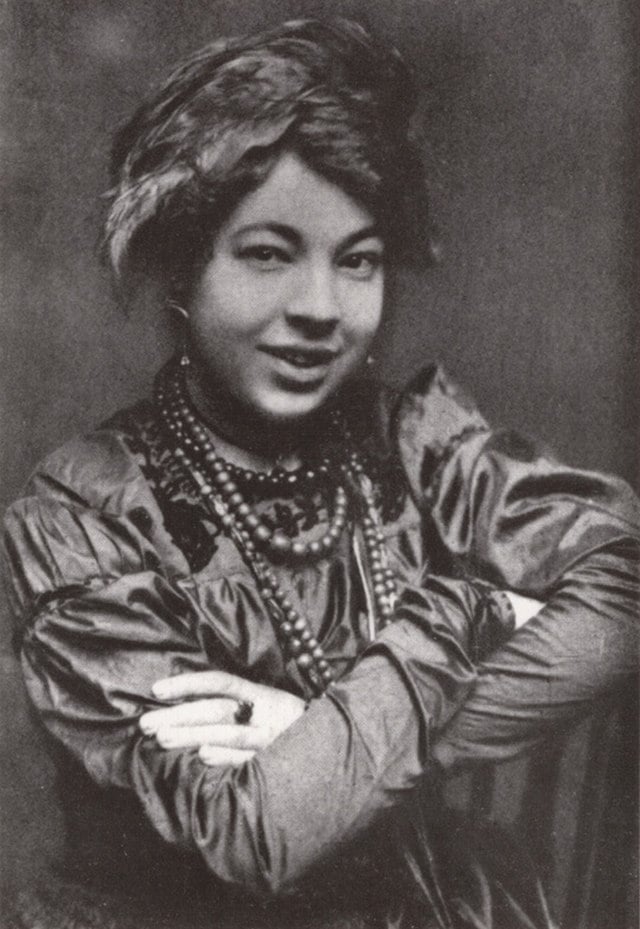
Katie White Share This Article
She’s the world’s most famous occult artist but her name is almost unknown.
Such is the enigma of Pamela Colman Smith (1878–1951), an early 20th-century artist, writer, and mystic. Smith created dreamy, Symbolist-inspired watercolors that won her acclaim in her youth, including three successful exhibitions at Alfred Stieglitz’s famed New York gallery, 291 where she was the first non-photographic artist to have a show.
She was also an intimate friend of Dracula writer Bram Stoker, poet William Butler Yeats, and the actress and artistic muse Ellen Terry, for whom Smith designed illustrations and stage sets.
However, Smith’s most lasting artistic contribution was undoubtedly her designs for the Rider-Waite tarot deck. Made in collaboration with mystic and scholar A.E. Waite, Smith created the Art-Nouveau-inspired imagery of mythical archetypes set against luminous monochromatic backgrounds. Released in 1909, the deck is now regarded as the standard set, with more than 100 million copies in circulation. Smith’s imagery has become synonymous with tarot itself.
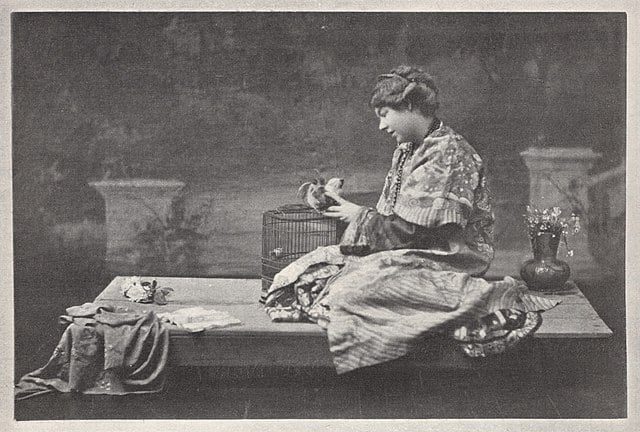
Pamela Colman Smith. Image in the public domain.
And yet, for more than a century, Smith went wholly uncredited for her contribution. Her claim to the deck was only cemented by her iconic serpentine signature, a monogram she created while studying Japanese design, and which she embedded into the decoration for every Tarot card.
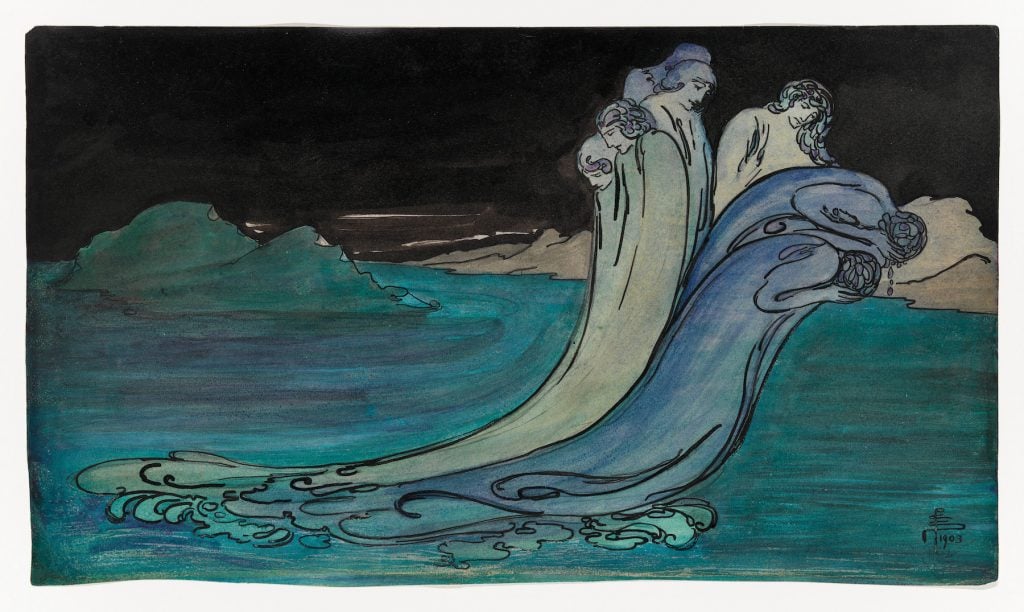
Pamela Colman Smith, The Wave (1903). Collection of the Whitney Museum of American Art.
“Tarot is a visual device—and yet the visual artist who composed them was eclipsed by Waite, the scholar, and Rider, the manufacturer,” said Micki Pellerano, a New York-based artist, astrologer, and scholar of occult history, “Academics, with all their inertia and corporatism, are somehow more palatable to the public and valuable to the market than artistry and vision… little has changed.”
But Smith has slowly been gaining recognition. The exhibition “At the Dawn of a New Age: Early Twentieth-Century American Modernism,” currently on view at the Whitney Museum of American Art, features an entire vintage set of the Rider-Waite tarot deck with attribution to Smith alongside The Wave, a luminous 1903 watercolor and ink drawing in the museum’s collection. The artist’s place in art history is still forming, however, and her contributions are more complex than a simple story of rediscovery.
Pamela Becomes Pixie
Born in London to upper-class American parents, Smith moved through a sophisticated and cultured circle, spending her childhood in New York and then Jamaica, where she would be profoundly shaped by that nation’s folkloric history. Smith returned to New York in 1893, enrolling in Pratt Institute, though she would leave after two years to pursue her own interests, then returning to London following the death of her mother.
She was deeply involved in the literary world and her early accomplishments include the illustrations for a volume of verses by William Butler Yeats (1898), as well as the publication of her own writing, Annancy Stories, a collection of Jamaican folktales, and Widdicombe Fair, an illustrated version of a popular English folk melody.
By 1901, she had established a weekly salon at her London studio and apartment, and she started her own journal, The Green Sheaf, which she edited as well as contributing her own poems and illustrations. She devoted herself to miniature theater as well, constructing dazzling and diminutive stage sets for toy performances.
The Annancy Stories particularly won Smith admirers and a bit of notoriety. Smith toyed with gender conventions, granting the women characters in these stories more agency, and sometimes making the gender of the characters ambiguous. She’d also written these stories in Jamaican patois, with which she was familiar from her childhood—an unconventional decision at the time.
Smith was familiarly known as Pixie, a nickname bestowed on her by Ellen Terry and which captured something of her undefinable, impish spirit. Smith was often known to wear flowing robes, and occasionally pants, and her self-styling welcomed all sorts of speculation. “She adopted native costumes and wore feathers in her hair and colorful ribbons. It was almost like a self-constructed persona that she adopted,” explained Barbara Haskell, curator of the Whitney exhibition, in a phone interview.
Her sexual orientation and her ethnic makeup also sparked curiosity. She lived for many years with Nora Lake, her companion and business partner, with whom she may have shared a romantic relationship. Others have speculated that Smith was of biracial descent, with an English American father and a mother of either Jamaican or East Asian ancestry—although not much evidence exists to lead to any decisive conclusions on the matter. What was certain is that Smith was regarded as “other” by those around her and which in turn inspired her approach to art-making.
Early Fame and Acclaim
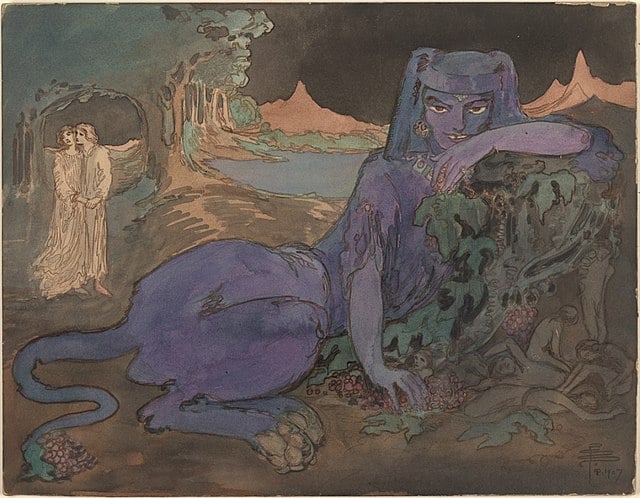
Pamela Colman Smith, The Blue Cat (1907). Collection of Alfred Stieglitz / Georgia O’Keeffe Archive, Yale Collection of American Literature, Beinecke Rare Book, and Manuscript Library.
In 1907, Smith had her first exhibition at 291, featuring 72 watercolor paintings. These works were partially inspired by Smith’s own synesthesia, in which she experienced visual sensations set off by auditory impulses (her first synesthetic experience occurred while listening to Bach). She organized her works for the show with overtlymusical references, such as overtures, sonatas, and concertos.
“In the 19th century, there was an idea that art was an expression of the unconscious and that it would elicit unconscious non-rational ways of thinking about the world,” Haskell said. “Smith would paint while listening to music as a way to unleash her unconscious, which would have fit Stieglitz’s mission at that point.”
This first exhibition was a commercial hit and Smith would have two more shows at the gallery in the following few years. Eleven of her unsold paintings and drawings remained in the collection of Stieglitz and Georgia O’Keeffe. Eventually, however, Stieglitz would turn to a more masculine vision of Modernism, leaving Smith somewhat disheartened.
The Embrace of the Occult
Pamela Colman Smith
In New York, October 1899, she meets Stoker again, as well as Henry Irving and Ellen Terry (just heroes and icons of the london theatre at the time) and talks them into letting her join the tour as one of the minor cast members.
Ellen Terry sort of adopts her and gives her the nickname "Pixie" which she embraces for the rest of her life.
Ellen Terry is kind of magic in and of herself.
She writes of mesmerizing audiences, entering into a mutual transformative trance with them, and there is just so much to be said about magic and the theatre in general, but let’s leave it behind the fourth wall and the red curtains for now and keep following our Pixie Witch.
Because, in December 1899, Pixie's father dies unexpectedly in New York. But she’s abroad with the theatre family, the only family she really has now, so she continues the tour, and then returns with them to London when it’s done.
In London she makes her living as an illustrator, and set designer, and works closely with William Butler Yeats and Bram Stoker and the Lyceum Theatre while also writing and illustrating books of her own.
Her style resonated with a visionary, romantic, modern seam in contemporary artistic practice and these big names of big men whose stories we are much more likely to know, recognized her as one of their own.
She independently publishes an artistic journal called the Green Sheaf with lots of writing on dreams, including new work by Yeats.
As a member of the Suffrage Atelier, a collective of professional illustrators, she also contributes artwork to fight for women's suffrage in Great Britain, and donates work to the Red Cross.
In 1907 she has a major show of 72 drawings and watercolours in NY - she is the first painter to have an exhibit in Alfred Stieglitz’s "Little Galleries of the Photo-Secession" and her show marks a turning point in the success of the gallery as it was the first non-photographic success of this space which would become famous for introducing the most avant-garde European artists of the time to America, including Henri Matisse, Auguste Rodin, Pablo Picasso, and Marcel Duchamp.
Well-known music and art critic, James Gibbons Huneker, reviewing the show wrote that "Pamela Colman Smith is a young woman with that quality rare in either sex - imagination." He called her painting entitled "Death in the House" "absolutely nerve-shattering" and said that not even Edvard Munch "could have succeeded better in arousing a profound disquiet." He wrote that the artist belonged to the "favored choir" of William Blake and his mystics.
Back in London, Pixie hosts a weekly “at home” for artists, performing stories from the Jamaican oral tradition, and from Yeats and others.
This young woman living all alone becomes a connector and a focal point for artists and thinkers.
At this time she’s living in parallel. She’s a working artist, who is also becoming immersed in magical ceremony in the Hermetic Order of the Golden Dawn.
Colman Smith was a member of the Golden Dawn, and then of the Independent and Rectified Rite of the Golden Dawn for about a decade.
The Golden Dawn at this time are an influential magical order that share some origins with other European hermetic - and heretical - societies and philosophies - the Freemasons and Rosicrucians - but differed in some pretty key ways for modern Bohemians: most especially in that they welcomed women in ‘perfect equality’ with men.
As Denisoff writes in his history “The Hermetic Order of the Golden Dawn, 1888-1901”:
“Golden Dawn members were primarily interested in magical philosophy and traditional ritual practice for the advancement of the individual’s spirit. Influences included ancient Egyptian religion, the Kabbalah, Christianity, Freemasonry, paganism, theurgy, alchemy, early-modern grimoires, and Enochian magic, such as that recorded by the early-modern occultist John Dee. Magic, for the Order, was the use of methodological practices to cause changes in consciousness and/or the material world in accord with the universal will…
The collective members of the Hermetic Order of the Golden Dawn ...made the nineteenth century’s most serious and sustained effort to re-imagine and re-engage with a prehistoric, occult tradition. In this sense, the Order can be seen as the major Victorian author of the often fictional, but no less influential history of occultism and natural magic.”
Colman Smith was a member at a time after secret documents of the order were left in a cab and publicized, and the order had fractured into pieces. Alistair Crowley - the queer sex magic beast of the hermetic schools at the time - was actively making fun of the leader of the group that Pixie stuck with, A.E. Waite. (Crowley was a racist and kind of an asshole.)
Waite has some of my sympathy. He brought some incredible translations and studies of hidden wisdom into the world, books on the Rosicrucians, the ancient Arthurian legends and more, but I guess he didn’t put it all together and light it all on fire in the way Crowley was ready to do. Waite was kind of tentative and his interpretations of the amazing texts he brought to light feel intentionally dense and convoluted, like he wasn’t ready to see something that was there and winking at him.
I think if you’ve ever woken up at night and felt a spiritsomething close to you, and chosen to turn on the TV or something to tune out that creepy feeling then you (and I) can maybe relate in part to what Waite might have been feeling.
What he did do though was recognize the importance of the Tarot, and the talent of his Pixie artist friend. He made notes from his research on the symbolism of the suits and of the major arcana and commissioned Pixie (“a big job for very little cash” as she said) to complete the pieces of art for the deck.
He is also pretty dismissive of her at times, and snide about her contributions, and doesn't even mention her name in a bunch of his writing about his new tarot deck.
But at another point in a letter he does say “I have embraced an opportunity which has been somewhat of the unexpected kind and have interested a very skillful and original artist in the proposal to design a set, Miss Pamela Coleman Smith in addition to her obvious gifts, has some knowledge of Tarot values; she has lent a sympathetic ear to my proposal to rectify the symbolism by reference to channels of knowledge, which are not in the open day.”
Norfleet notes “Waite had some very strong ideas about the design of the 22 trump cards of the Major Arcana, but he was relatively unconcerned with the 56 cards of the Minor Arcana. Pamela had almost full creative reign with respect to those cards. Each card in the deck was to receive a unique illustration; in all, a total of 80 unique images would need to be created (78 tarot cards plus the designs for the card back and the nameplate).Prior to this time, tarot decks had never been manufactured in the English-speaking world.”
The origins of Tarot are unknown. Tarot seems to pop up in Europe around the 14th Century as a deck of cards used in games of chance and divination. It’s sometimes called “the book of divination of the gypsies” as the gypsy roma people were its main keepers for centuries.
There is a great story about the Egyptian origin of the tarot from a French occult philosopher Dr Papus, recounted in Ralph Metzner’s 1971 history “Maps of Consciouness”. Metzner FYI is the Harvard educated psychologist who participated in psychedelic research at Harvard University in the 1960s with Timothy Leary and Richard Alpert (also known as Ram Dass). Metzner’s been into consciousness research, including psychedelics, yoga, meditation and shamanism for over 45 years, and I feel like he takes pleasure in the fact that this story comes to us with it’s source “mysteriously concealed by Papus” as he puts it.
The story goes... “that Egyptian priests when faced with the imminent destruction of their temples and orders held a council to decide how to transmit their teachings. “At first they thought of confiding these secrets to virtuous men recruited by the initiates themselves who would transmit them from generation to generation. But one priest, observing that virtue is a most fragile thing … proposed to confide the scientific traditions to vice. (Vice) he said would never fail completely and through it we are sure of a long are durable preservation of our principles.”
I love this sourceless story too, and especially the idea that you can trust vice better than virtue to stay steady and survive and pass things on.
Metzner continues:
“It has been proposed that the 22 cards which make us the major arcana of the Tarot were, in the Egyptian Mystery Schools, hung on the walls of a gallery in the form of tablets or paintings, along with hieroglyphs and other symbols. The initiate had to pass through the gallery elucidating the meaning of the symbols as a kind of test….”
And in the Aquarian Gospel of Jesus the Christ, a version of the life of Jesus supposedly transcribed from the akashic record, Jesus is described as passing through such a series of tests in an Egyptian school.”
The earliest known deck to use the structure of 22 Major Arcana and 56 Minor Arcana cards is the deck of the Sola Busca family, created by an unknown artist in Venice around 1490. While other decks float around this is really the only one with an illustration for every card until Pixie’s - instead of just a number and suit for the minor arcana - and it feels full of magic. There are layers of references to alchemical philosophy in the cards - not just the greedy secrets turning lead into gold, but the alchemy of the transmutation of the soul. The magic of becoming one with the divine, or the universe, of dreaming the god dream. These tarot aren’t just for fortune telling, they contain as Metzner puts it “symbols representing actual tools and methods of psychic transformation.”
These tarot aren’t just for fortune telling, they contain “symbols representing actual tools and methods of psychic transformation.”
Images of the Sola Busca deck were acquired by the British museum just a few years before Colman Smith began her project with Waite and there are some clear references and influences. And also clear points of departure. Check out the Ten Of Swords in the Sola Busca vs the Waite Smith, and then check out the Ten Of Wands in Waite Smith - it’s almost as though Waite and Smith intentionally said, no, that imagery of hoarding away belongs in the path of the wands. At this same stage in the path of swords the image is defeated in another way, and much more violent. The ten swords pierce the body dead on the floor... but in the sky a storm hovers on the edge of sunshine. It is hopelessness with a golden dawn on the horizon. This deck, made in London just a breath before the word tumbles into the darkness and tragedy of a world war, is a whole new map made in direct reference to a palimpsest of symbols that came before.
And while we can see from Waite’s studies and notes that he provided some clear direction, Pixie had all the power of an artist creator - she drew her friends into the cards, and her own visions of the world beyond this one. World’s she accessed through art.
In 1908 for Strand Magazine Pixie discussed her experience of synesthesia.
"You ask me how these pictures are evolved," said Miss Colman Smith. "They are not pictures of the music theme — pictures of the flying notes—not conscious illustrations of the name given to a piece of music, but just what I see when I hear music—thoughts loosened and set free by the spell of sound.
"When I take a brush in hand and the music begins, it is like unlocking the door into a beautiful country. There, stretched far away, are plains and mountains and the billowy sea, and as the music forms a net of sound the people who dwell there enter the scene; tall, slow-moving, stately queens, with jewelled crowns and garments gay or sad, who walk on mountain - tops or stand beside the shore, watching the water - people. These water-folk are passionless, and sway or fall with little heed of time; they toss the spray and, bending down, dive headlong through the deep.
"There are the dwellers, too, of the great plain, who sit and brood, made of stone and motionless; the trees, which slumber till some elf goes by with magic spear and wakes the green to life; towers, white and tall, standing against the darkening sky…
For a long time the land I saw when hearing Beethoven was unpeopled; hills, plains, ruined towers, churches by the sea. After a time I saw far off a little company of spearmen ride away across the plain. But now the clanging sea is strong with the salt of the lashing spray and full of elemental life; the riders of the waves, the Queen of Tides, who carries in her hand the pearl-like moon, and bubbles gleaming on the inky wave.
"Often when hearing Bach I hear bells ringing in the sky, rung by whirling cords held in the hands of maidens dressed in brown. There is a rare freshness in the air, like morning on a mountain-top, with opal-coloured mists that chase each other fast across the scene.
"Chopin brings night; gardens where mystery and dread lurk under every bush, but joy and passion throb within the air, and the cold moon bewitches all the scene. There is a garden that I often see, with moonlight glistening on the vine-leaves, and drooping roses with pale petals fluttering down, tall, misty trees and purple sky, and lovers wandering there. A drawing of that garden I have shown to several people and asked them if they could play the music that I heard when I drew it. They have all, without any hesitation, played the same. I do not know the name, but— well, I know the music of that place."
In 1911 Pixie converted to Roman Catholicism, and though she claimed it was “such fun” it was certainly not an easy choice in Protestant England, and it might also have been lonely. She withdrew from most of her former friends at this time, and her artistic output slowed. In 1913 she illustrated Ellen Terry's book The Russian Ballet. In 1913 she published the illustrated book entitled Bluebeard. And in 1914 she Illustrated Eunice Fuller's work entitled The Book of Friendly Giants, which if you are a fan of Roald Dahl’s the BFG you must check out.
Norfleet writes that in late 1918, Pamela received a legacy from a deceased uncle. This money gave her the freedom to set up her life in Cornwall in southwest England. Norfleet is of the opinion that “she chose that area because Pixies were believed to be particularly concentrated in the region around Devon and Cornwall. She always thought herself a pixie who really didn't fit in well among ordinary humans. She once told W. B. Yeats that she had been able to see fairies in Ireland.
An article in faerie magazine from 2017 gives a little more insight into what those years might have been like.
“Colman Smith died in 1951, in Bude, Cornwall, where she lived in a home bought with an inheritance from an uncle. The occupation listed on her death certificate reads “Spinster of Independent Means.” Though just a decade earlier she had been recognized by the Royal Society for the Encouragement of Arts, Manufactures, and Commerce, she was not listed as an artist and was making a meager living running a home for vacationing Catholic priests… her estate was willed to her “flatmate” Nora Lake, a reputed spiritualist and Colman Smith’s likely lover; the two had been companions for forty years. Although nothing definitive is written about the artist’s sexual predilections, she never married, was linked to no men, and spent her time in the company of women, many of them known queers such as the handsome Edith “Edy” Craig, a bisexual suffragist who famously lived in a ménage-à-trois with a straight couple until her death. Craig was also the model for the Queen of Wands in Colman Smith’s tarot.”
I was telling my beautiful witch friend Sue about Coleman Smith’s story and got to this part about Cornwall and faeries and she said ‘oh I lived there! It’s heavy witchy. It’s almost encircled by water, cliffs and beaches and then in the middle it’s the moors. You can walk around there and find old stone circles. I was up there at night once to see the stars and a fox walked right up to me. Stood and stared at me for way too long.’
I love to imagine Pixie there. I can see getting enough of busy London, tiring of a heavily ritualized and performance-based magical scene, and heading for the sea. Making up a new personal practice inspired both by Catholicism's mysteries, and by your love with the beautiful name and the uncanny intuitions, Nora Lake. Balanced between the moor and the sea.
Often Pixie is characterized as dying penniless and unappreciated and though it’s infuriating that she didn’t earn the royalties she deserves for the most popular tarot deck of all time, I think she did live a kind of magical life right to the end. She lived 40 years with her love and best friend, no small achievement in its own right for any of us. She had independent means and a job where she was her own boss, caring for - and I imagine whispering sacred and profane secrets with - old catholic priests. And in the Tarot cards, she left images of her friends, of her visions, of her personal vast understanding of the symbolism shared between cultures and linking our minds to each other, and to the spirit world.
She left a map that deepened our understanding beyond words... like she was hearing a distant music and translating in for millions of seers to come.
In 1908 she wrote an article for Craftsman Magazine - the principal voice of the Arts and Crafts Movement in the United States - called “Should The Art Student Think?” We’ll end our first episode with this, and try to take Pixie’s advice to heart for all our practices of art... and send it with love to all you witches and all the ways you’re all out there bringing about magic:
“Keep an open mind to all things. Hear all the music you can, good music, for sound and form are more closely connected than we know.
Think good thoughts of beautiful things, colors, sounds, places, not mean thoughts. When you see a lot of dirty people in a crowd, do not remember only the dirt, but the great spirit that is in them all, and the power that they represent.
For through ugliness is beauty sometimes found.
….
Banish fear, brace your courage, place your ideal high up with the sun, away from the dirt and squalor and ugliness around you and let that power that makes "the roar of the high-power presses" enter into your work - energy - courage - life - love. Use your wits, use your eyes. Perhaps you use your physical eyes too much and only see the mask. Find eyes within, look for the door into the unknown country.”
Resources:
http://littleredtarot.com/ancestors-pamela-colman-smith/
https://en.wikipedia.org/wiki/Pamela_Colman_Smith
O’Connor, Elizabeth Foley (2016). "We disgruntled devils don’t please anybody”: Pamela Colman Smith, The Green Sheaf, and Female Literary Networks
http://pcs2051.tripod.com/stieglitz_archive.htm
http://pcs2051.tripod.com/arts_and_crafts.htm
Stuart R. Kaplan, The Artwork and Times of Pamela Colman Smith (2009)
https://faeriemagazine.com/divine-mystery-pamela-colman-smith/
http://bude-past-and-present.org.uk/update-on-pamela-colman-smith/
https://swedenborg.com/emanuel-swedenborg/influence/
Denisoff, Dennis. “The Hermetic Order of the Golden Dawn, 1888-1901.” BRANCH: Britain, Representation and Nineteenth-Century History. Ed. Dino Franco Felluga. Extension of Romanticism and Victorianism on the Net.


Няма коментари:
Публикуване на коментар